BCIS is a leading provider of reliable, up-to-date reinstatement cost data for both residential and commercial properties. Whether you’re a surveyor completing rebuild cost assessments, or an insurer or broker seeking to identify outdated or inaccurate valuations, the independent, verified and auditable data from BCIS is an essential tool. To find out more, book a demonstration with our team.
Published: 13/05/2026
BCIS’s involvement in insurance rebuilding costs began with a straightforward challenge: helping insurers establish more reliable sums insured for residential properties.
In October 1977, the British Insurance Association (which joined with other organisations to form the Association of British Insurers in 1985) formally commissioned BCIS to develop a standardised approach to household rebuilding costs. The aim was to support a more consistent approach to setting sums insured and updating them over time.
The original brief was relatively modest in scope. BCIS was asked to produce rebuilding guidance covering standard brick-built houses across broad regional groupings, with rebuilding costs expressed on a £/m² basis. The intention was to help insurers and householders arrive at sums insured that more closely reflected rebuilding exposure.
Nearly 50 years since BCIS first made its rebuilding guidance and House Rebuilding Cost Index available to the insurance market in 1978, those same objectives continue to shape BCIS’s insurance offering, although the scale, sophistication and breadth of the tools available have evolved significantly.
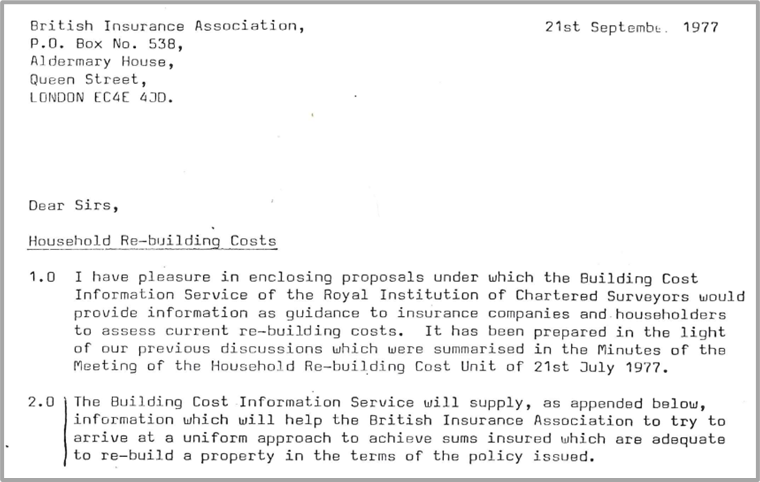
BCIS was commissioned by the British Insurance Association to develop a standardised approach to household rebuilding costs.
Establishing the foundations
The 1977 proposal already recognised several ideas that remain central to reinstatement cost assessment today. It acknowledged that rebuilding cost is fundamentally different from market value, that index linking cannot correct an inaccurate starting point and that regional pricing differences matter. Just as importantly, it recognised that rebuilding assessments require professional judgement and that indices should support, rather than replace, periodic reassessment.
The original documents repeatedly stressed that the guidance being developed could only provide broad assistance within what BCIS described as a “very heterogeneous market”. Individual reinstatement assessments, it noted, would remain “the province of professional valuers and surveyors”.
That principle has remained consistent throughout the development of BCIS’s insurance services.
The first House Rebuilding Cost Index (HRCI) was introduced in July 1978, just months after the original commission. Initially published quarterly before becoming monthly in 1981, the index was designed to help insurers update residential sums insured between full reassessments.
The approach was based on recalculating standard rebuilding models to reflect changes in labour, materials, plant, contractor overheads, profit and fees. Importantly, the HRCI was never intended to replace professional reassessment. Instead, it was designed as a mechanism for updating between reviews.
That distinction remains central to the way BCIS approaches residential index-linking today.
Expanding beyond residential rebuilding
Over time, the original rebuilding guidance evolved into a much broader and more sophisticated insurance offering.
What began as a relatively limited framework covering standard houses gradually expanded to incorporate wider ranges of house types and age bands, purpose-built flats and conversions, external works, district and postcode-based adjustments, sustainability technologies and increasingly detailed reinstatement assumptions.
As the system evolved, BCIS’s Rebuild Online emerged as a comprehensive professional decision-support platform rather than simply a rebuilding guide.
At the same time, BCIS’s understanding of regional pricing differences became significantly more sophisticated. Early references to “economic regions” led to use of BCIS’s location factor methodology, which combines recent regional tender price differences with long-term intra-regional variation.
Crucially, these location factors are not direct measures of £/m² cost differences between locations. Instead, they are derived from observed tender pricing behaviour and are intended to reflect how pricing levels vary geographically across the construction market.
Applying construction cost data to commercial reinstatement
While BCIS’s formal insurance offering began with residential rebuilding guidance in 1978, BCIS project data and cost intelligence had already been supporting commercial reinstatement assessment since the 1960s. Tools such as BCIS Average Prices and detailed project analyses gave surveyors and cost professionals access to rebased project data and comparative market evidence to support the preparation and maintenance of commercial reinstatement assessments.
Alongside this, BCIS offered tender price indices to help maintain commercial reinstatement figures between periodic reassessments. Where the House Rebuilding Cost Index focuses on maintaining residential sums insured, the BCIS All-in Tender Price Index (TPI) became widely used to rebase commercial reinstatement figures in line with changing market pricing conditions.
Together, these tools helped establish a clearer distinction between the processes of setting and maintaining reinstatement figures – using project data and benchmarking evidence to inform the initial assessment, and indices to maintain consistency between periodic reviews.
From guidance to construction cost intelligence
Perhaps the most significant evolution since 1977 has been BCIS’s transition from a rebuilding guidance provider into a broader construction cost intelligence platform for insurance professionals.
Today, BCIS supports rebuild cost decision-making across the insurance life cycle, from point of quote through to portfolio monitoring and reinsurance modelling. BCIS data underpins the ABI reinstatement calculator and supports more than 35 million rebuild cost calculations each year through insurers, brokers and major price comparison websites.
Modern BCIS insurance tools now sit within a wider ecosystem that includes reinstatement cost assessment models, residential rebuilding indices, tender price indices, location factors, benchmarking studies, average price analyses and, in development now, groundbreaking property intelligence datasets.
This evolution reflects broader changes across the insurance market itself. Rebuild cost assessment is no longer simply about maintaining individual sums insured. Insurers and brokers increasingly require portfolio-level visibility, operational consistency, auditability and stronger insight into underinsurance exposure.
The next stage: portfolio-scale rebuild assessment
That shift has informed the development of Rebuild Plus, BCIS’s portfolio-scale rebuild cost assessment platform.
Rebuild Plus combines BCIS construction cost data with workflow management, portfolio analysis and reporting capabilities to support insurers, brokers, surveyors and asset managers in delivering rebuild cost assessments at scale.
Rather than focusing solely on individual properties, the platform is designed to help organisations identify underinsurance exposure across portfolios, manage reinstatement assessment workflows, maintain consistency across large datasets and support governance and audit requirements.
The platform reflects how reinstatement assessment has evolved from a largely standalone surveying activity into a broader data, risk and portfolio management challenge.
At the same time, the underlying philosophy remains consistent with the principles established in the original 1977 commission.
BCIS tools continue to support professional judgement rather than replace it. Rebuild Plus is designed for standard construction types and typical specifications, while specialist or heritage properties still require experienced surveying input and bespoke assessment.
Looking ahead, BCIS is continuing to expand the role that data can play in helping insurers better understand rebuilding exposure at both property and portfolio level.
This next stage of development is centred around property intelligence – bringing together proprietary rebuild cost data with wider property information from multiple trusted sources to create a more complete view of individual assets.
The intention is not simply to produce rebuild figures more efficiently, but to generate deeper insight into the characteristics, risks and factors that may influence reinstatement exposure across large property portfolios.
As insurers increasingly seek stronger visibility, consistency and governance around sums insured, this combination of construction cost expertise, portfolio workflow and connected property data is likely to play an increasingly important role in the future of rebuild cost assessment.
Nearly five decades of continuity and change
The evolution of BCIS’s insurance offering since the 1970s reflects both continuity and transformation.
The original British Insurance Association commission established the foundations for residential rebuilding models, insurance index-linking, regional pricing adjustments, periodic reassessment frameworks and modern reinstatement assessment practice.
Over time, those foundations expanded into a broader construction cost intelligence ecosystem supporting residential and commercial reinstatement, portfolio management, benchmarking, underwriting, pricing strategy, reinsurance modelling and property risk analysis.
What has remained consistent throughout is the central objective: helping the insurance market maintain rebuild cost assessments that more closely reflect rebuilding exposure.
What has changed is the sophistication of the data, the scale of the modelling and the ability to apply those insights across entire property portfolios.
To keep up to date with the latest industry news and insights from BCIS, register for our newsletter here.