BCIS CapX includes price adjustment formulae, a method of calculating the increase, or decrease, in contractors’ costs over any period. The formulae and indices (over 200 of them) are widely used in various sectors in the construction industry, including civil engineering contracts and facility management.
Published: 18/09/2026
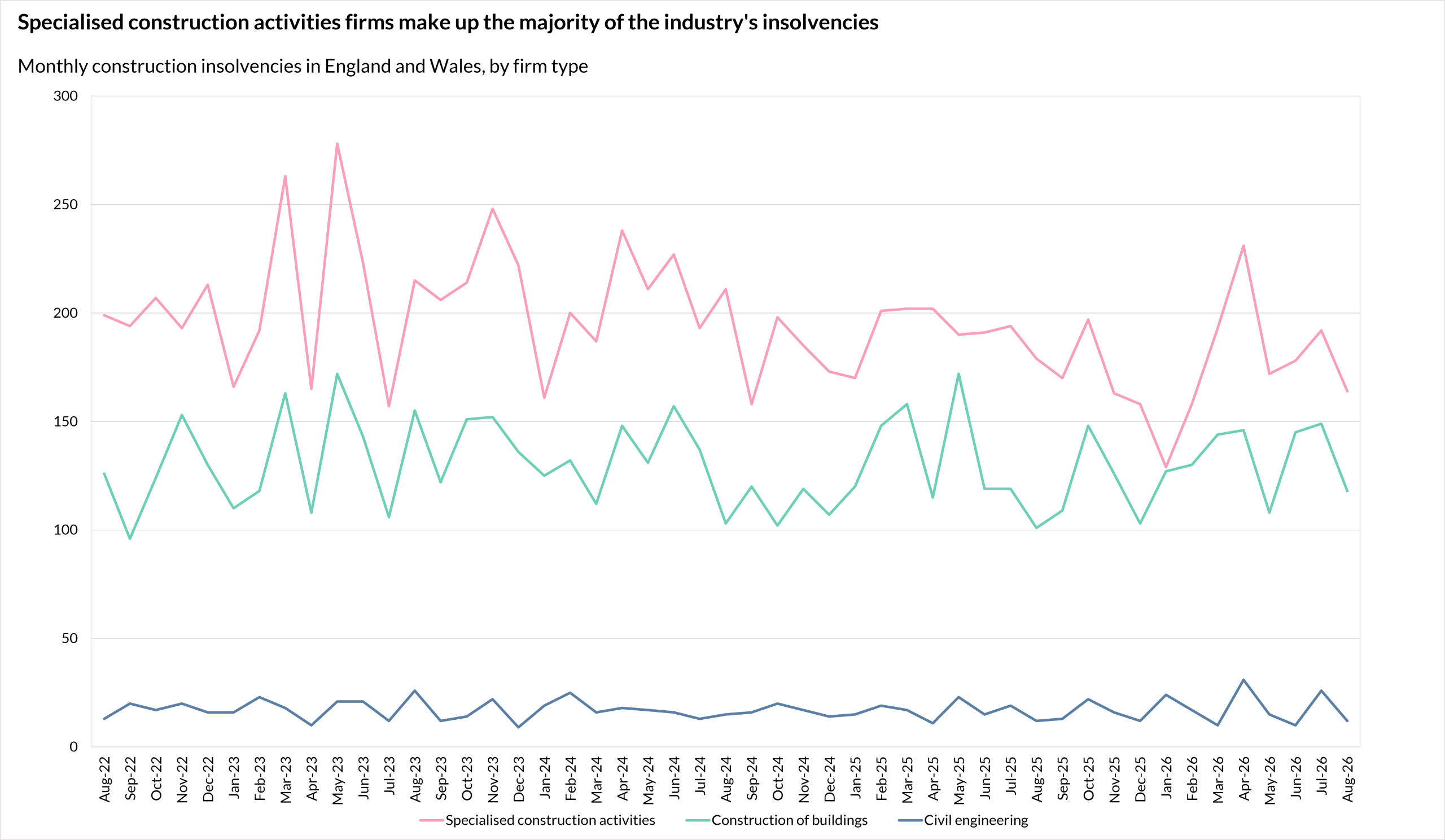
Construction firms accounted for 16% of all insolvencies in England and Wales in August 2026, according to The Insolvency Service(1), with 294 registered construction businesses becoming insolvent.
This was 73 fewer than the 367 recorded in July 2026 and two more than in August 2025.
By comparison, construction firms accounted for 14%(2) of all registered businesses in the UK as of September 2025.
The largest proportion of construction insolvencies were among firms providing specialised construction activities with 164 recorded in August.
The total number of construction firms becoming insolvent in the 12 months to August 2026 was 3,866. This was a 2% decrease on the 3,941 insolvencies recorded in the year ending in August 2025 but a 20% increase on the 3,221 in pre-pandemic 2019.
Source: The Insolvency Service – Company Insolvency Statistics June 2026, Table 1c
Sam Parkin, senior economist at BCIS, said: ‘Insolvencies in construction eased in August, demonstrating some resilience amid challenging conditions. However, with insolvencies consistently elevated compared with pre-pandemic times, the market seems to be adjusting to different demand conditions, which shouldn’t be understated. In other words, this could be new normal, or a period of transition to a new normal, as indicated by recent BCIS industry panel commentary.
’That aside, the geopolitical outlook is deteriorating in the Middle East, with increases in oil and natural gas prices persistent, which means firms will continue to face uncertainty and headwinds.
‘At the same time, financial markets are pricing in further interest rate hikes in the coming months and government borrowing costs remain elevated as the Bank of England continues quantitative tightening.
‘Together, these factors will likely feed through to the cost of construction while sustained uncertainty restrains demand and investment appetite for new work. With this in mind, the industry’s resilience will continue to be tested, particularly that of specialist and smaller firms that often feel the brunt of postponed or cancelled projects.’
Across all industry sectors, construction experienced the highest number of insolvencies in the year to August 2026.
The Insolvency Service said that while the insolvency rate has increased since the lows seen in 2020 and 2021, it remains much lower than the peak of 113.1 per 10,000 companies seen during the 2008-09 recession. This is because the number of companies on the effective register has more than doubled over this period. The rate in the year to the end of August 2026 was 50.1 per 10,000 companies(3).
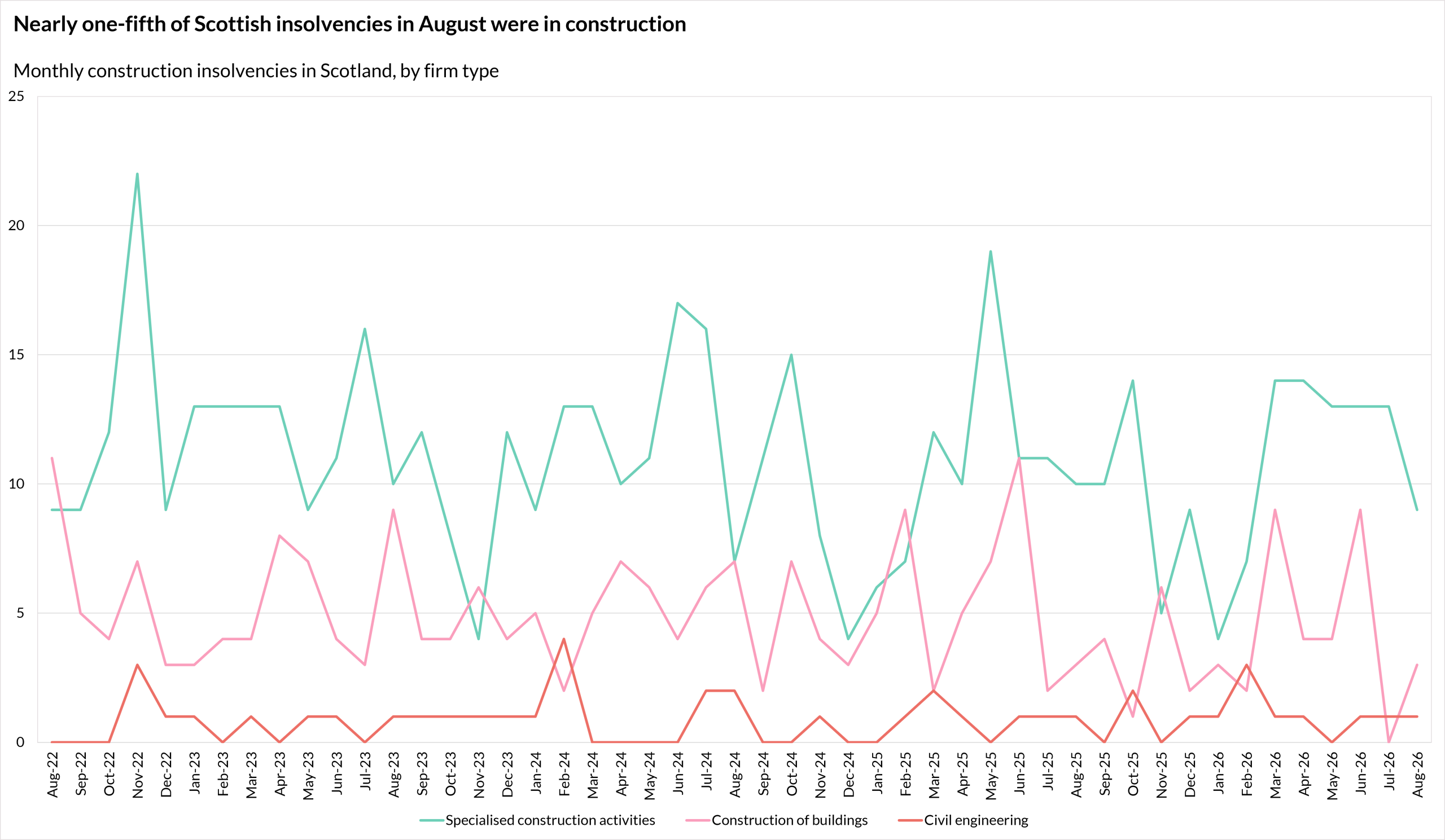
In Scotland, there were 13 construction company insolvencies in August 2026, one fewer than in July 2026, accounting for 18% of all insolvencies in the country.
The number of Scottish construction insolvencies for the 12-month period August 2026 was 184, eight less than the 192 in the year to August 2025, and an 11% decrease on the 207 in pre-pandemic 2019.
Source: The Insolvency Service – Company Insolvency Statistics June 2026, Table 4b
Within the industry, firms classified as providing specialised construction activities are consistently the most affected across Great Britain. However, analysis shows that their numbers are proportional to their overall share within the construction sector.
This category includes companies providing a range of work, typically on a subcontract basis, from demolition and site preparation to electrical and plumbing installation, and finishing work like plastering, painting and glazing.
The Insolvency Service also publishes figures for Northern Ireland, but not with sector breakdowns.
The latest analysis of profit warnings issued by listed construction companies by EY-Parthenon suggests that housebuilders in particular are facing difficult trading conditions.
FTSE Household Goods and Home Construction firms, which include housebuilders, issued six warnings in 2Q2026, bringing the sector’s total to ten in the first half of the year.
Commentary pointed to the combined weight of higher energy and input costs, weaker consumer confidence and fading expectations of near-term interest rate cuts. EY-Parthenon also reported that measures to stimulate sales, including mortgage contributions, deposit support and part-exchange schemes, have come at the expense of profit margins.
A multitude of factors feed into company insolvency, though analysis of profit warning data by EY suggests the construction industry is particularly exposed to financial difficulty.
This is in part due to the nature of contract cycles and the challenges of cash flow management that contractors and subcontractors are subject to.
An effective way of mitigating the risks associated with fixed-price contracts when costs are so changeable is to use fluctuation clauses linked to work category and resource-specific inflation indices, such as those available in BCIS CapX.
BCIS Price Adjustment Formulae Indices (PAFI), covering more than 200 work activities across building, civil engineering, specialist engineering and highways maintenance, can also be used throughout the budgeting and procurement stages to plan cash flow more effectively.
To keep up to date with the latest industry news and insights from BCIS, register for our newsletter here.