The Building Cost Information Service (BCIS) is the leading provider of cost and carbon data to the UK built environment. Over 4,000 subscribing consultants, clients and contractors use BCIS products to control costs, manage budgets, mitigate risk and improve project performance. If you would like to speak with the team call us +44 0330 341 1000, email contactbcis@bcis.co.uk or fill in our demonstration form
Published: 15/10/2026
The Office for National Statistics (ONS) publishes monthly estimates of the amount of construction output chargeable to customers for building and civil engineering work in Great Britain, split by sector and type of work(1).
Construction output falls again as new work decline deepens annual downturn
Monthly construction output decreased in August 2026, falling by 0.2% on July 2026, according to the latest ONS data.
New work was down by 0.7% on the month, while repair and maintenance (R&M) increased by 0.4%. The biggest monthly changes were in new public housing, down by 3.8%, and public housing R&M, down by 2.0%.
On an annual basis, total construction output fell by 1.8% in August 2026. New work declined by 5.8% compared with August 2025, while repair and maintenance (R&M) output increased by 3.6%.
Infrastructure and private commercial were the only new work sectors to see annual increases in output, recording 1.0% and 1.5% rises respectively. The largest annual decrease was a 28.8% fall in new public housing output.
In R&M, both public and private housing output increased on the year, by 3.1% and 5.1% respectively.
| Sector | Change in August 2026 compared with | |
| July 2026 | August 2025 | |
| New work | ||
| Public housing | -3.8% | -28.8% |
| Private housing | -1.9% | -8.7% |
| Infrastructure | 0.0% | 1.0% |
| Public other | 0.2% | -14.5% |
| Private industrial | -1.7% | -7.7% |
| Private commercial | 0.6% | 1.5% |
| All new work | -0.7% | -5.8% |
| Repair and maintenance | ||
| Public housing | -2.0% | 3.1% |
| Private housing | 1.3% | 5.1% |
| Non-housing | 0.1% | 2.3% |
| All R&M | 0.4% | 3.6% |
| All work | -0.2% | -1.8% |
Source: ONS – Output in the construction industry, Table 2a
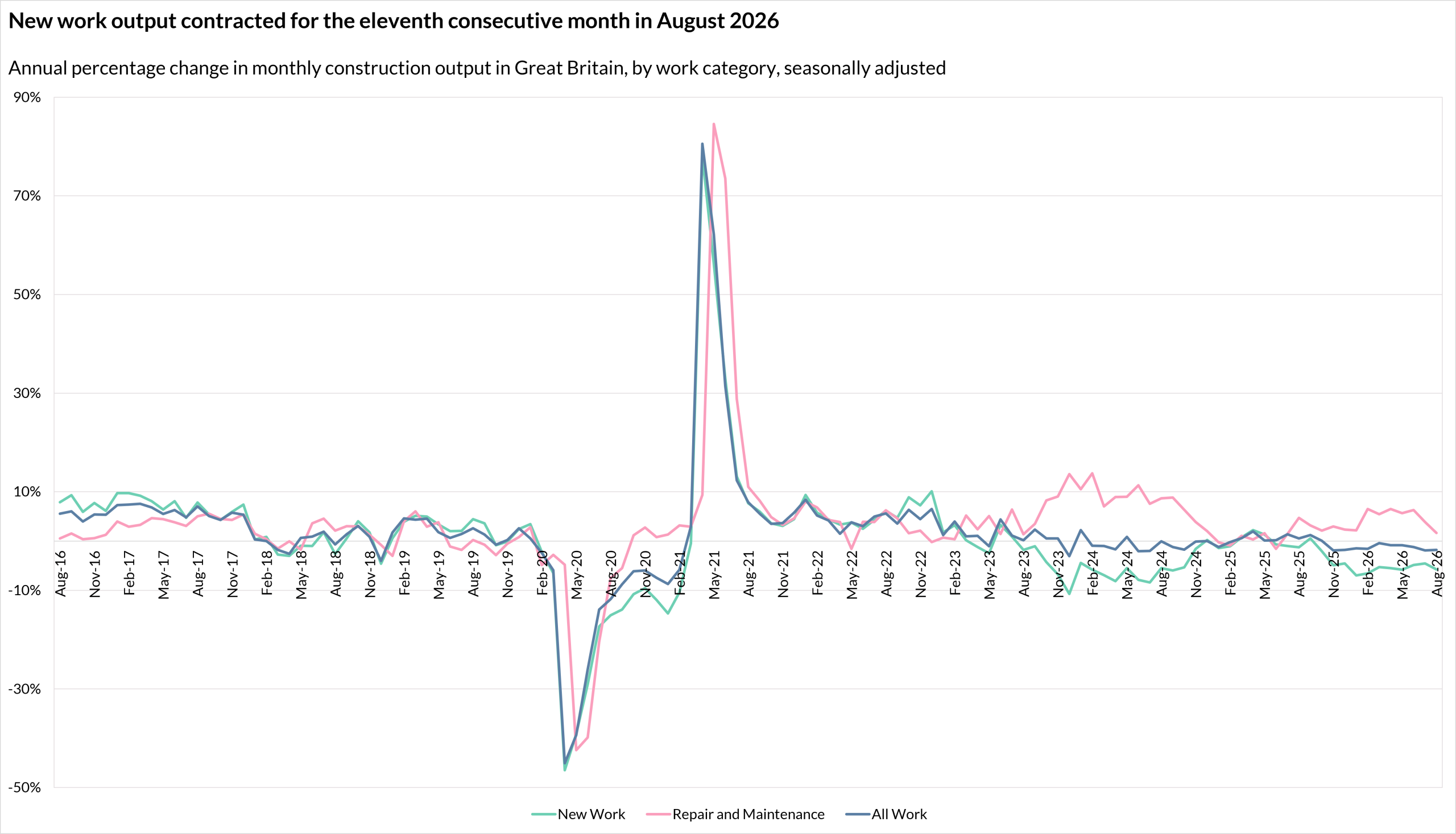
Source: ONS – Output in the construction industry, Table 2a
Dr David Crosthwaite, chief economist at BCIS, said: ‘The latest ONS data suggest construction output is holding back wider economic growth. While a slight uplift in GDP in August is no doubt welcome, it is not cause for celebration.
‘Construction, when performing well, is a powerful engine of economic growth. However, output has either contracted or remained relatively subdued on a quarterly basis for much of this year. The annual picture is even more concerning, with the ONS’s seasonally adjusted All Work index recording annual declines for ten consecutive months.
‘The government must recognise the role it can play in reversing this trend. While it has limited influence on geopolitical events and their impact on energy markets, or wider supply-side pressures affecting particular commodities, there are levers within its control.
‘Fiscal policy and spending commitments can help stimulate investment, while measures to ease business cost pressures could improve project viability and support delivery. Beyond reaffirming housing and infrastructure funding and providing greater certainty through the next update to NISTA’s infrastructure pipeline, these could include extending the freeze on fuel duty and avoiding further increases in statutory wage thresholds and employers’ National Insurance contributions.
‘Sector-specific interventions are also needed. With both public and private new housing output declining in August, the government must urgently examine the cumulative costs of development and consider what concessions or targeted support could help improve project viability.’
Real GDP grew by 0.7% in the three months to August 2026. Construction output fell by 1.0% in the same period while output in the services and production sectors rose by 0.9% and 0.2% respectively.
To keep up to date with the latest industry news and insights from BCIS, register for our newsletter here.
(1) Office for National Statistics – Output in the construction industry - here