The Building Cost Information Service (BCIS) is the leading provider of cost and carbon data to the UK built environment. Over 4,000 subscribing consultants, clients and contractors use BCIS products to control costs, manage budgets, mitigate risk and improve project performance.
Published: 02/09/2026
As the government pushes ahead with its plans to boost housebuilding, BCIS chief economist Dr David Crosthwaite examines the challenges around viability that could stand in the way of its ambitions.
The government has set its devolution agenda firmly in motion, announcing a raft of measures in recent weeks designed to strengthen the powers of local planning and mayoral authorities, stimulate housebuilding and support local growth.
Planning reform and funding allocations will certainly support development, but their impact is likely to be limited without progress on viability. It remains a significant barrier to new construction, particularly in the housing market, and is directly restricting the scale of growth the government is seeking to achieve.
Put simply, a scheme may have planning permission but will not necessarily be built if the expected value of the completed development does not sufficiently outweigh the costs and risks involved in delivering it.
Data published by the Home Builders Federation (HBF) make this abundantly clear.
One survey of SME housebuilders showed 91% believed the Building Safety Levy, due to come into effect on 1 October 2026, will make developments less financially viable(1). More than one-third reported delaying, redesigning or cancelling schemes in anticipation of its introduction.
Other findings revealed almost three-quarters of respondents cited low buyer confidence as the greatest demand-side constraint for housebuilding(2), followed by wider housing market conditions (70%).
It is this combination of cost pressures – including those arising from energy market volatility, regulatory compliance and general building cost inflation – alongside softer demand for new housing – that is weighing on activity and prompting developers to scale back site acquisitions and project starts.
Further data published by the HBF(3) show the number of sites granted planning permission for private housing in England fell to a record low in 1Q2026. Office for National Statistics figures also indicate that public and private housing construction output fell by 14.8% and 6.7% respectively in the 12 months to the second quarter of 2026.
Meanwhile, the latest sales data from the Mineral Products Association (MPA)(4) confirm that sales of ready-mixed concrete, aggregates and mortar in the first half of 2026 remained well below last year’s levels, providing further evidence of the sustained downturn in housing activity.
Scaling back activity is not an easy choice for housebuilders, particularly SME developers operating on tighter margins. Earlier in the year, EY-Parthenon insight revealed that the FTSE Household Goods and Home Construction sector, which includes housebuilders, recorded the highest proportion of companies issuing profit warnings of any FTSE sector in the year to 2Q2026, at 58%.
At present, there is significant risk that inaction on costs and demand and an exclusive focus on planning reform could push more businesses to the brink of insolvency, undermining capacity and delivery across the housebuilding sector.
Record-level data published monthly by The Insolvency Service suggest this risk is already materialising to a certain extent.
According to SIC 2007 codes, insolvencies among companies classed under the construction of domestic buildings have trended upwards since 2016. This category encompasses single- and multi-family housing, including high-rise developments, as well as housing association and local authority housing(5).
Moreover, since 2023, more than 500 firms in this SIC category have entered insolvency each year, exceeding the level recorded in every earlier year of the past decade.
Insolvencies among firms involved in the construction of commercial buildings have also increased, although to a lesser extent by comparison.
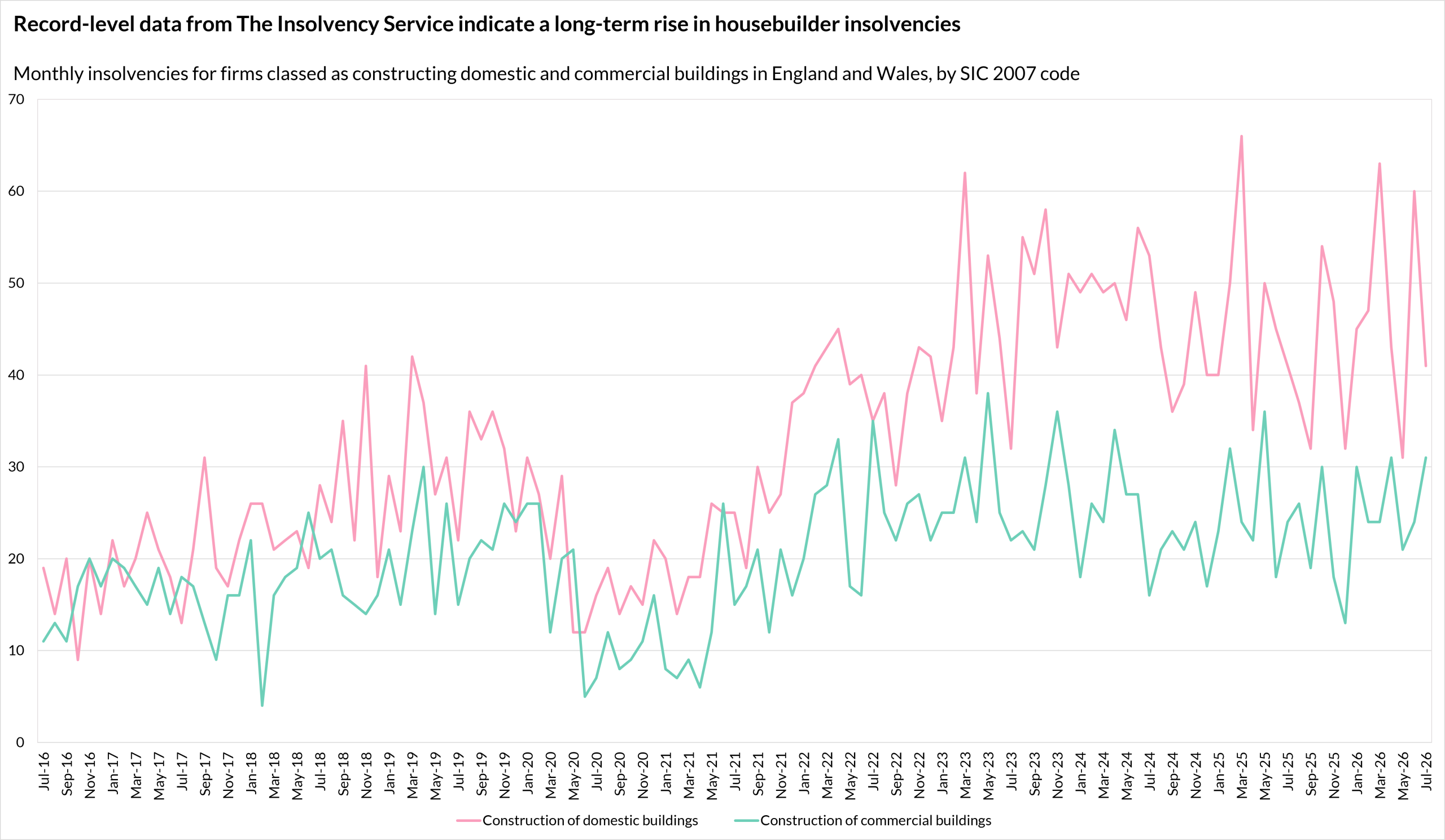
Source: The Insolvency Service – Record-level data for England, Wales and Scotland – Company Insolvency Statistics July 2026
These figures are a relatively broad measure of conditions in housebuilding. SIC codes cover a wide range of businesses and caution is required when interpreting record-level data. Treatment of non-trading and dormant companies can differ from the monthly tables published by The Insolvency Service, while the industry classification of some companies is unknown(6).
Even with these limitations, the trends are consistent with evidence of a difficult operating environment. As regulatory requirements have intensified, macroeconomic pressures have simultaneously made costs and market demand more uneven and less predictable.
For policymakers, the implication is that planning reform and funding alone will not be sufficient to translate development ambitions into construction activity.
The Autumn Budget, due to be delivered on 28 October, presents an opportunity to reinforce confidence and stimulate activity, with several avenues open to the government.
For example, the Housing, Communities and Local Government (HCLG) Committee published a report in June(7) recommending reform of stamp duty to help more first-time buyers onto the housing ladder. It called on the government to launch a consultation by the end of 2026 on potential alternatives to the current system.
Options proposed for consideration include replacing stamp duty entirely with a revenue-neutral alternative, reducing rates to stimulate transactions, overhauling banding thresholds so they better reflect local property prices and remain relevant over time, and updating reliefs and exemptions to align better with government objectives.
Other industry bodies, including the HBF, have focused more heavily on addressing development costs. The HBF has called on the government to review further policy costs, taxes and levies on housebuilding, alongside an assessment of the unprecedented increase in costs arising from policies introduced across government departments in recent years. It has also questioned whether the Building Safety Levy should be introduced at all.
This warrants consideration, particularly as the government has just announced a proposed expansion of the Mayoral Community Infrastructure Levy (MCIL) beyond London.
While MCIL has helped fund major infrastructure in the capital, extending the model carries a risk of adding to development costs, especially where developers are also liable for existing Community Infrastructure Levy (CIL) charges. Any expansion must therefore consider the cumulative effect of these obligations on scheme viability.
There is also some scope to improve coordination between local authorities, registered providers and developers over Section 106 arrangements. Earlier engagement could help ensure that affordable housing requirements reflect what registered providers can realistically fund and acquire, reducing the risk of protracted renegotiations or schemes stalling. Making this type of collaboration standard practice could provide greater clarity for all parties and help viable developments progress more quickly.
Increasing housebuilding is an inherently difficult challenge for government. Delivery remains heavily dependent on private developers, whose decisions on when and how much to build are shaped by costs, demand, financing conditions and the wider market.
Planning reform is an essential part of the solution, but permissions alone will not deliver a sustained recovery in housebuilding. Achieving that will require realistic and actioned government-industry collaboration to improve viability, strengthen confidence and create the conditions in which developers can build at greater scale.
To keep up to date with the latest industry news and insights from BCIS, register for our newsletter here.
(1) HBF – Nine in ten SME house builders warn Building Safety Levy will make even more sites unviable - here
(2) HBF – SME Developer Sentiment Survey August 2026 - here
(3) HBF – Number of new home sites granted planning permission falls as housing supply continues to flatline - here
(4) MPA – Housing downturn deepens as concrete and mortar slump - here
(5) GOV.UK– FOI22/23-151 – Request relating specifically to house builders - here
(6) GOV.UK– Commentary – Company Insolvency Statistics July 2026 - here
(7) UK Parliament– Reform stamp duty to help get first-time buyers on the housing ladder, says Housing Committee - here