If you are a housebuilder or developer, please fill in the survey. If you have any questions or would like to discuss the survey, please call +44 0330 341 1000 or email contactbcis@bcis.co.uk
Published: 09/09/2026
Each month, Lloyds, Nationwide and HM Land Registry publish house price indices, tracking the movement in average house prices in the UK. Lloyds and Nationwide updates are based on mortgage approvals data, while the UK House Price Index (HPI) is a joint production by HM Land Registry, Land and Property Services Northern Ireland, ONS and Registers of Scotland.
The Halifax House Price Index was renamed the Lloyds House Price Index in July 2026. The methodology is unchanged and the index is already based on both Halifax and Lloyds mortgage data.
House price growth remained muted in August
UK house price growth remained subdued in August, with the latest indices pointing to a mixed picture across the housing market.
Lloyds(1) reported that house prices contracted 0.4% year-on-year and by 0.2% on the month. Meanwhile, Nationwide’s index(2) recorded annual growth of 1.6% and monthly growth of 0.2%.
The figures arrive as mortgage approvals remain below recent levels. Bank of England data show net mortgage approvals for house purchases fell to 56,100 in July, compared with an average of around 60,800 over the previous six months(3).
Dr David Crosthwaite, chief economist at BCIS, said: ‘The latest house price data continue to underline a sense of hesitancy in the market, with buyers less willing to commit to purchases and sellers reluctant to reduce prices. I suspect the domestic economic situation will keep demand and house price growth relatively subdued for the time being.
‘An improvement in borrowing rates over the coming months, alongside greater stability in the wider economy, would help strengthen the outlook. That would be particularly welcome for private housing developers, who will be watching closely for signs of a sustained recovery in demand. However, given the escalation of hostilities in the Middle East, I suspect a cut to Bank Rate is unlikely.’
According to the Financial Conduct Authority(4), which collects mortgage lending data via the Mortgage Lending and Administration Return, the value of new mortgage commitments (lending agreed to be advanced in the coming months) increased by 1.4% in 2Q2026 from the previous quarter to £79.2 billion and was 1.3% higher than a year earlier.
Andrew Asaam, mortgages director at Lloyds, said the housing market had faced a more difficult backdrop in recent months as global events impacted inflation and borrowing costs, fuelling greater uncertainty.
He said: ‘What we’re not seeing is a rush of homeowners cutting prices. But more are choosing to sit tight, with sellers reluctant to accept offers they feel are too low, while some buyers are waiting to see how conditions develop. As a result, fewer homes are changing hands, with latest industry figures showing mortgage approvals now at their lowest level since the start of 2024.’
Nationwide’s chief economist, Robert Gardner, concurred that soft market activity and house prices partially reflected the uncertain economic backdrop.
He added: ‘Market expectations of the future path of Bank Rate have been volatile. While the latest energy price shock poses inflation risks, there have been encouraging signs that it is not feeding through to underlying price pressures. Indeed, private sector wage growth has eased further in recent months, which should give policymakers breathing space to assess the extent to which tighter policy is necessary to ensure inflation returns sustainably to target.’
The UK HPI (5), with the latest data for June 2026, showed a 2.0% increase in house prices compared with June 2025 and a 0.1% increase on May 2026.
As the UK HPI figures cover house sales that may have been agreed in months previously, there tends to be a lag in the data.
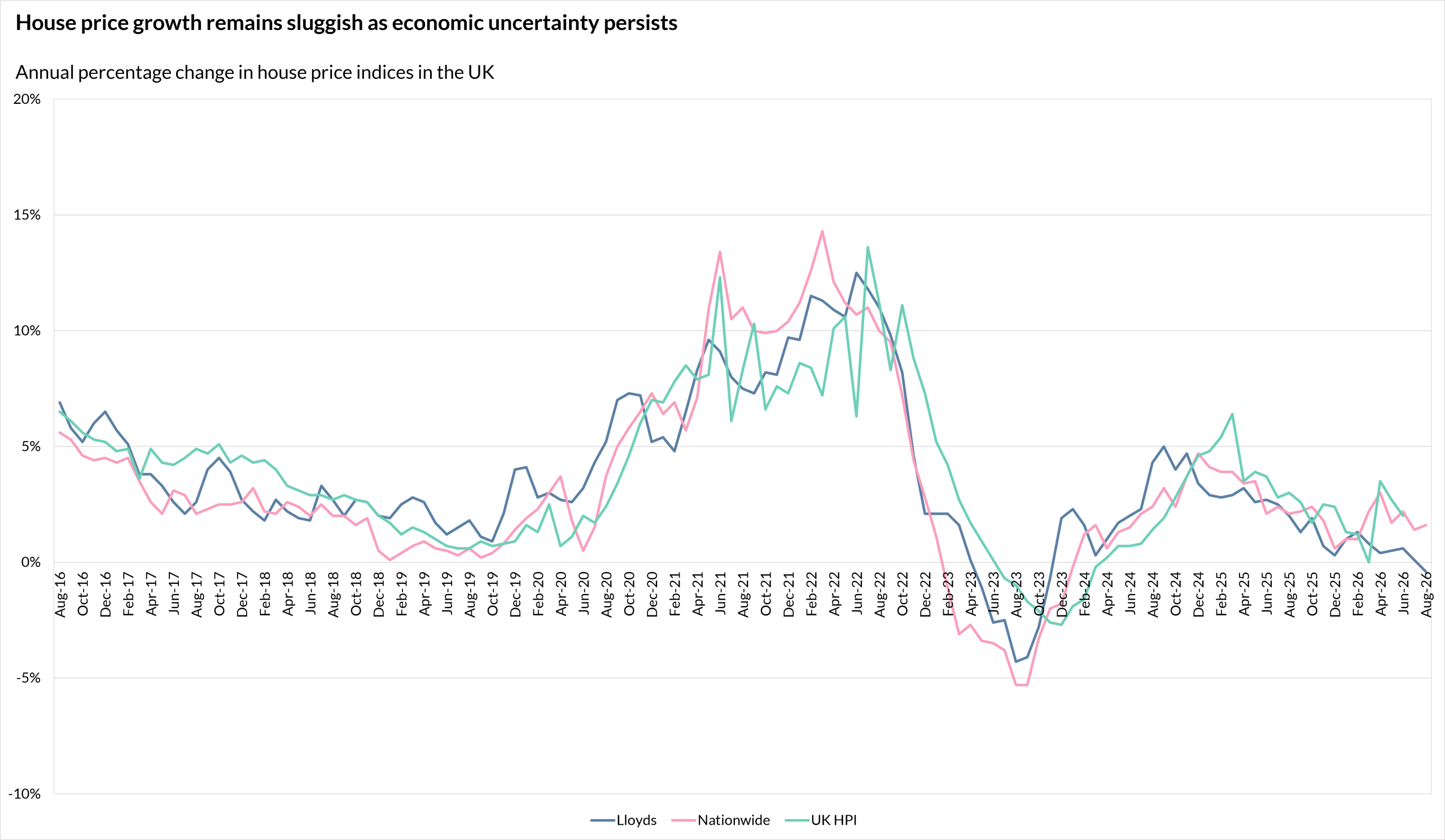
Source: Lloyds (Methodology), Nationwide (Methodology), UK HPI (Methodology)
The latest regional data from Nationwide show Northern Ireland, the North West and the North recorded the greatest annual house price increases in 2Q2026. Northern Irish house prices rose by 8.6% while prices in the North West and the North both increased by 3.9%.
In 2Q2026, the UK as a whole saw annual house price growth of 2.2% on the same quarter in 2025.
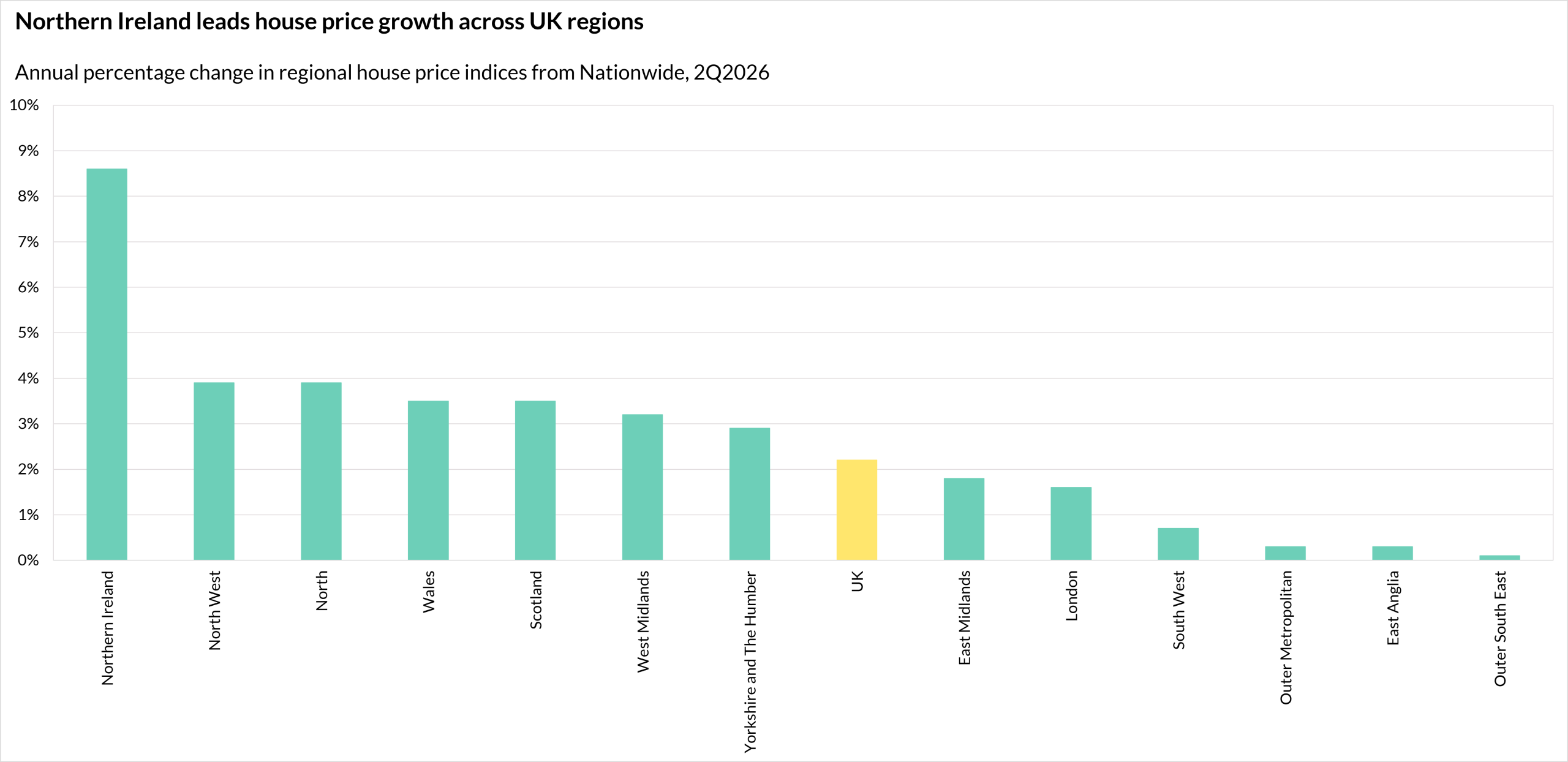
Source: Nationwide – Quarterly Regional House Price Statistics – Q2 2026
To keep up to date with the latest industry news and insights from BCIS, register for our newsletter here.