The Building Cost Information Service (BCIS) is the leading provider of cost and carbon data to the UK built environment. Over 4,000 subscribing consultants, clients and contractors use BCIS products to control costs, manage budgets, mitigate risk and improve project performance. If you would like to speak with the team call us +44 0330 341 1000, email contactbcis@bcis.co.uk or fill in our demonstration form
Published: 05/03/2026
Building Safety Regulator makes headway on decisions, remediation backlog remains
366 decisions were made on applications for building control approval by the Building Safety Regulator (BSR) in the 12 weeks ending on 25 February 2026, new data has shown(1).
This was fewer than the 698 decisions made in the 12 weeks to 23 January 2026, the period of focus in the BSR’s previous report.
The latest data also confirmed that 655 new applications were submitted for building control approval in the same period, bringing the total number of live applications across all project categories to 1,212 as of 25 February.
Karl Horton, data services director at BCIS, said: ‘The BSR continues to make good headway on streamlining its workflows, achieving noticeable improvements in the pace of decision-making undertaken by the Innovation Unit.
‘However, with the gateway 2 bottleneck looking a little more manageable attention has shifted to gateway 3. A number of freedom of information requests have highlighted similar holdups at gateway 3 though the BSR claims no new build, higher-risk building that has passed gateway 2 has applied for gateway 3 approval yet.
‘The cost implications of regulatory delays, regardless of fault, cannot be overstated. While the BSR continues to balance process reform with upholding better safety standards, the industry must maintain robust, financial due diligence and set clear, realistic expectations of programme timelines with clients.’
Decisions on all approved applications took a median time of 30 weeks in the 12 weeks ending on 25 February.
Decisions on rejected applications took a median time of 25 weeks while withdrawn applications took 33 weeks. Both timeframes have fallen since the previous BSR report.
This data relates to applications submitted for building control approval – a statutory requirement for work on higher-risk buildings (HRBs) to pass the regulatory stop/go point known as gateway 2.
Applications for building control approval are used by the BSR to assess compliance with building regulations, project management due diligence and the competency of project teams(2).
Data by application type
As of 25 February 2026, the Building Safety Regulator (BSR) was processing 155 live applications for new build projects.
The majority (123 applications) were being managed by the BSR’s Innovation Unit (IU). A further 21 legacy new build cases remained under review. Although this backlog has reduced from the 29 cases recorded on 23 January, the BSR has now missed its own deadline to clear it.
Of the remaining legacy cases, three are classified as ‘regular’ applications while 18 are considered technically complex and are therefore being handled through a separate process.
In the 12 weeks leading to 25 February, the BSR determined 108 new build applications, an increase on the previous reporting period, and received 82 new submissions.
Elsewhere, 279 live remediation applications sat in the BSR’s system on 25 February.
By comparison, decisions made on these types of application took longer than the majority of new build cases.
In the 12 weeks to 25 February, the IU took a median time of 18 weeks to approve applications, 11 weeks for rejections and 12 weeks to resolve withdrawn applications.
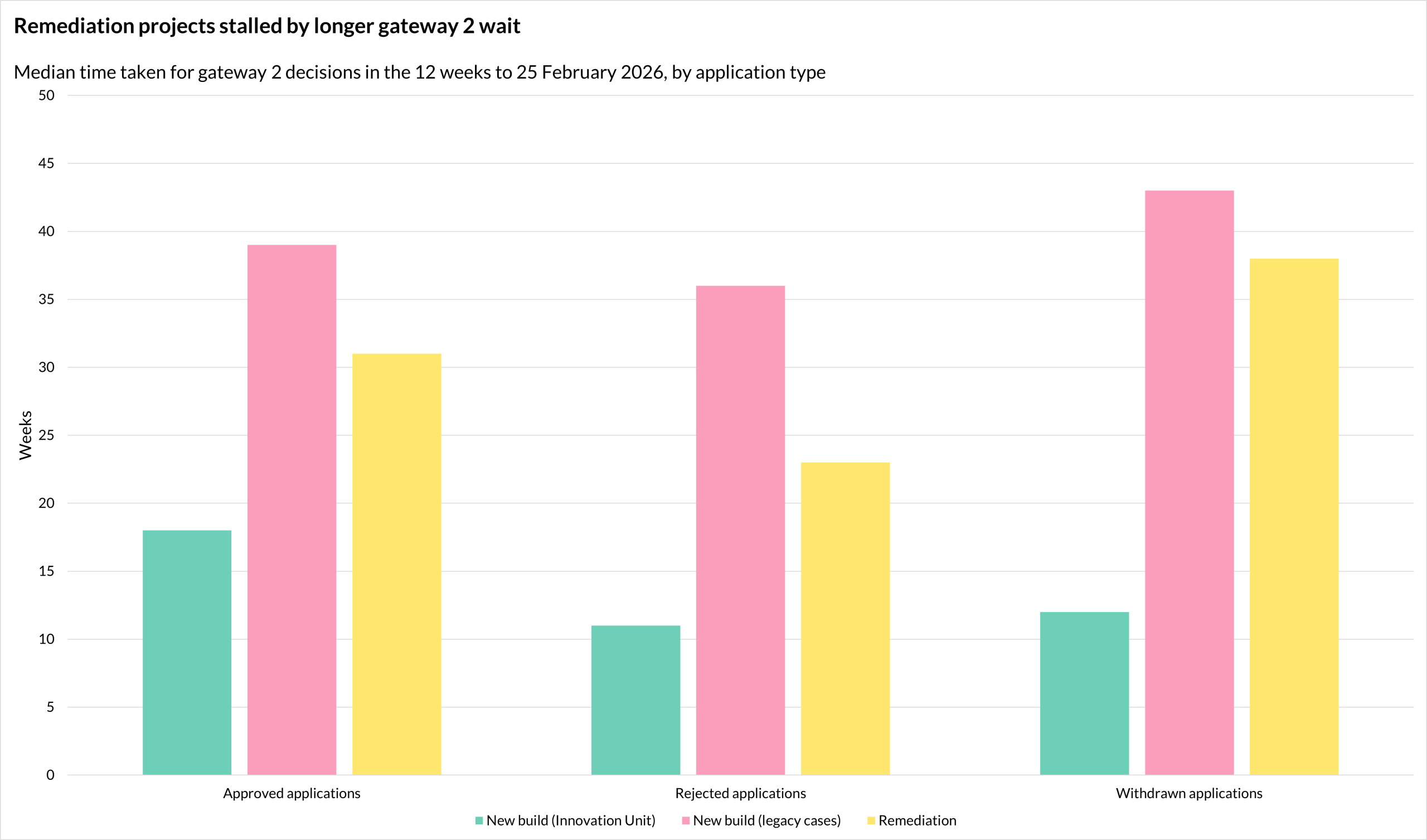
Source: BSR – Building control approval application data, December 2025 to February 2026
Meanwhile, decisions on remediation applications took a median time of 31 weeks to approve, 23 weeks to reject and 38 weeks to be withdrawn.
Reporting on data for remediation applications, the BSR said: ‘Remediation applications are often missing important elements of detail needed to demonstrate compliance. In response to this, we will be publishing specific remediation guidance in the coming weeks alongside improved feedback and support for applicants.
‘This month, we will also introduce a more detailed remediation improvement plan which will set out how we intend to bolster resources, improve processes and work with applicants to improve application quality.’
London-based projects requiring building control approval comprise a larger share of all gateway 2 applications than projects across the rest of England combined.
Remediation applications outnumber applications for other types of work across all regions including London.
Since September 2025, the BSR has been piloting a new batching process to accelerate backlog resolution in new build and remediation applications.
To keep up to date with the latest industry news and insights from BCIS, register for our newsletter here.