BCIS CapX includes price adjustment formulae, a method of calculating the increase, or decrease, in contractors’ costs over any period. The formulae and indices (over 200 of them) are widely used in various sectors in the construction industry, including civil engineering contracts and facility management.
Published: 18/03/2026
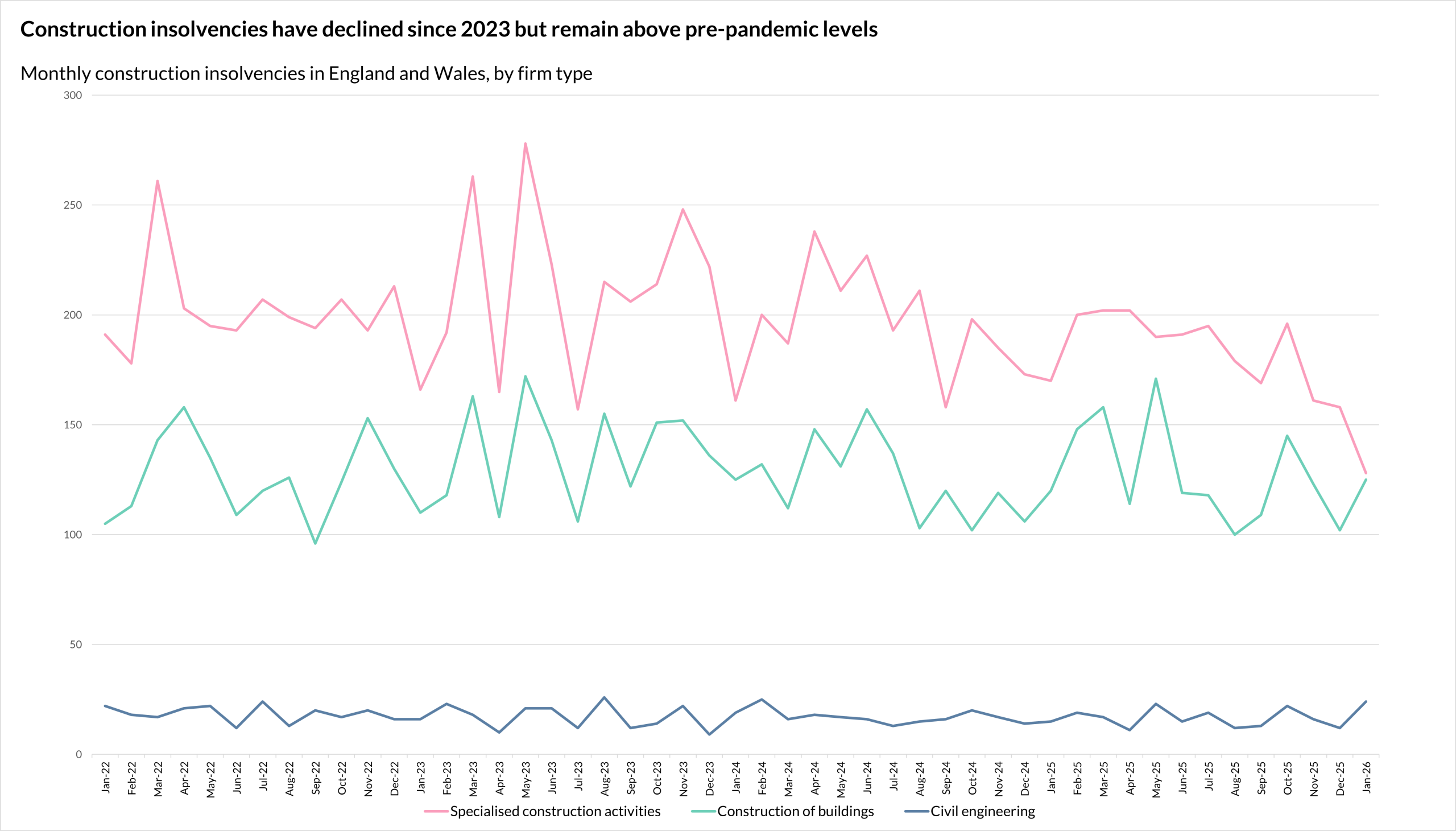
Construction firms accounted for 17.1% of all insolvencies in England and Wales in January 2026, according to The Insolvency Service(1), with 277 registered construction businesses becoming insolvent.
This was five more than had been recorded in December 2025 and was fewer by 28 on the 305 recorded in January 2025.
By rough comparison, construction firms accounted for 14%(2) of all registered businesses in the UK as of September 2025.
The largest proportion of construction insolvencies were among firms providing specialised construction activities with 128 recorded in January – 30 fewer than those recorded in December.
The total number of construction firms becoming insolvent in the 12 months to the end of January 2026 was 3,912. This was a 3.2% decrease on the 4,040 insolvencies recorded in the year ending in January 2025 and a 21.5% increase on the 3,221 in pre-pandemic 2019.
Source: The Insolvency Service – Company Insolvency Statistics January 2026, Table 1c
Karl Horton, data services director at BCIS, said: ‘Construction insolvencies appear to be easing from the peaks seen in recent years. January 2026 saw the lowest number of construction insolvencies of any January in the past three years of available data, continuing a downward trajectory across annual data between 2023 and 2025.
‘However, recent volatility means there is no room for complacency. Construction insolvencies remain above pre-pandemic levels, with spikes in 2022 and 2023 partly driven by supply chain disruption and inflationary pressures linked to Russia’s invasion of Ukraine. Current geopolitical uncertainty also poses risks to input costs, project viability and new starts, with the potential to push insolvencies higher again if instability persists.
‘In this environment, transparent communication between clients and contractors, fair risk allocation and robust financial due diligence, including effective benchmarking and the use of appropriate indices to monitor underlying inflation, are more critical than ever.’
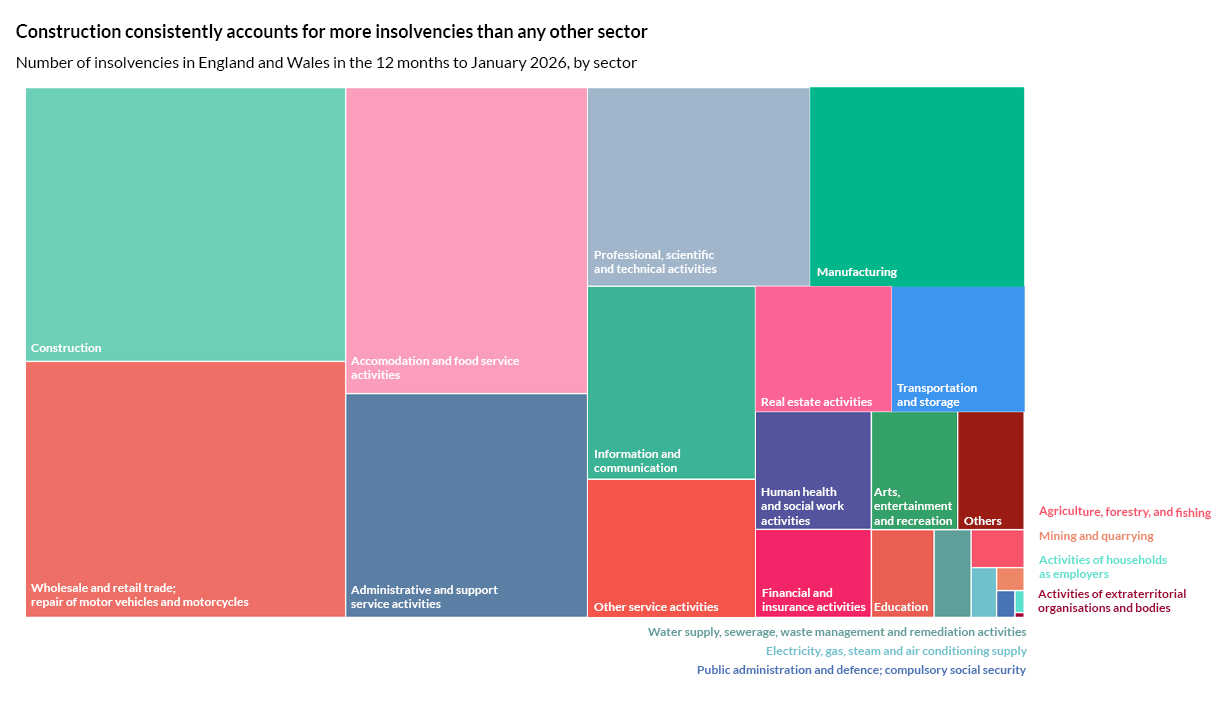
Of all cases where the industry was captured in the statistics, construction experienced the highest number of insolvencies in the year to January 2026.
Source: The Insolvency Service – Company Insolvency Statistics January 2026, Table 1c
The Insolvency Service said while the insolvency rate has increased since the lows seen in 2020 and 2021, it remains much lower than the peak of 113.1 per 10,000 companies seen during the 2008-09 recession. This is because the number of companies on the effective register has more than doubled over this period. The rate in the year to the end of February 2026 was 51.5 per 10,000 companies(3).
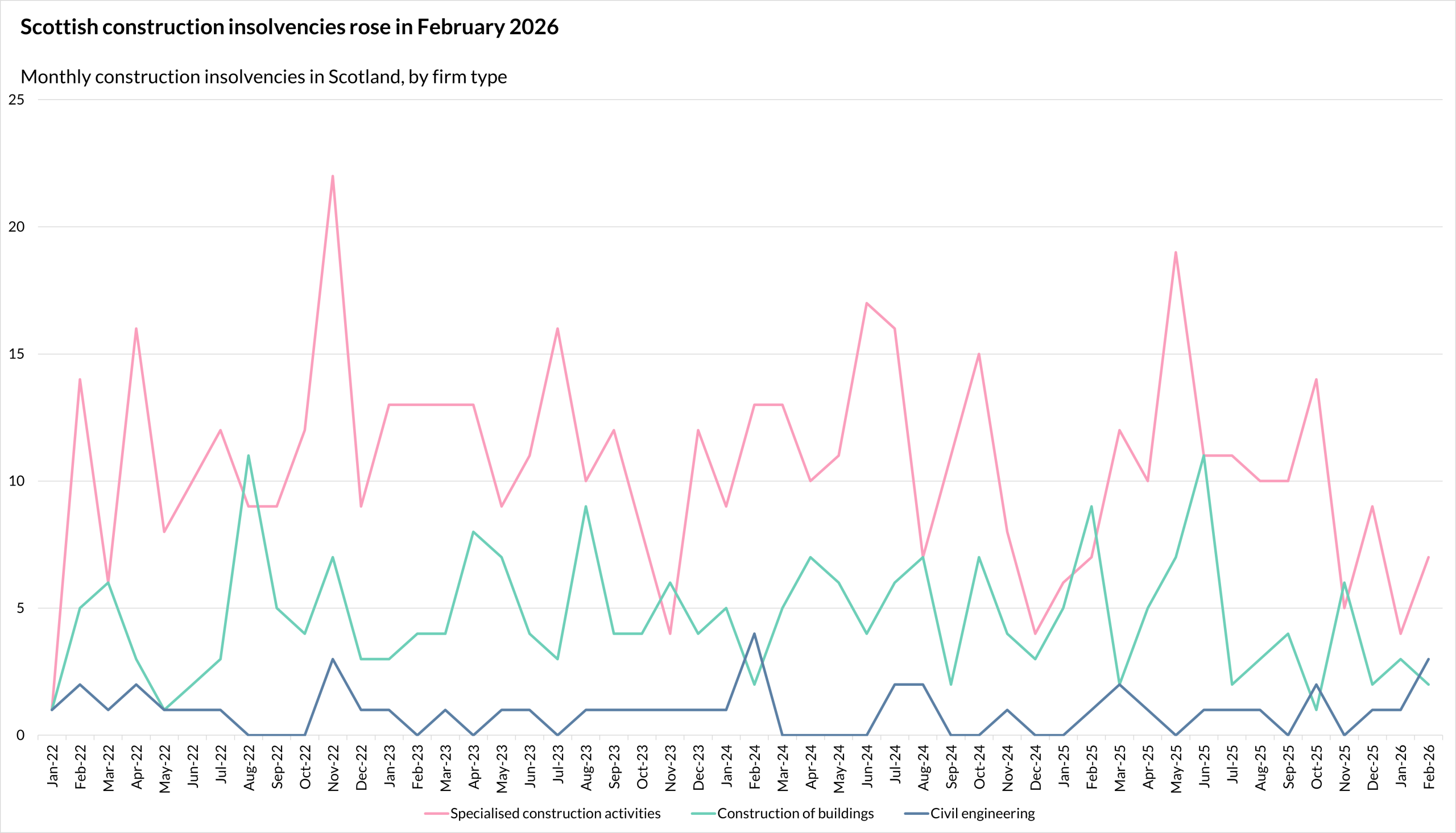
In Scotland, there were 12 construction company insolvencies in February 2026, four more than in January 2026, and accounting for 12.2% of all insolvencies in the country.
The number of Scottish construction insolvencies for the 12-month period to February 2026 was 183. This was a 6.6% decrease on the 196 recorded in the year to February 2025 and a 11.6% decrease on the 207 in pre-pandemic 2019.
Source: The Insolvency Service – Company Insolvency Statistics January 2026, Table 4b
Within the industry, firms classified as providing specialised construction activities are consistently the most affected across Great Britain. However, analysis shows that their numbers are proportional to their overall share within the construction sector.
This category includes companies providing a range of work, typically on a subcontract basis, from demolition and site preparation to electrical and plumbing installation, and finishing work like plastering, painting and glazing.
The Insolvency Service also publishes figures for Northern Ireland, but not with sector breakdowns.
Analysis by EY-Parthenon(4) on profit warnings issued by listed construction companies has shown particular vulnerabilities in the industry.
In 2025, profit warnings issued by FTSE Construction and Materials firms in the UK were more than triple the number issued in 2024.
Over half of these cited weaker confidence, delays in contract starts or slippage in project timelines. Labour shortages, legacy liabilities, rising employment costs and increasing regulatory complexity were also highlighted as sources of disruption and pressure in the report.
Looking forward, EY-Parthenon’s summary said: ‘In 2026 stress is still broad-based. Many retailers are weighed down by rising costs, weak sentiment and increasing investment needs. Meanwhile, sectors such as chemicals and construction continue to struggle with high input costs, regulatory pressures and fragile demand.
‘Healthcare providers report intensifying cost and spending pressures. As a result, confidence remains fragile and risks continue to evolve, and we expect restructuring pressures to continue to build in the year ahead.’
A multitude of factors feed into company insolvency, though analysis of profit warning data by EY suggests the construction industry is particularly exposed to financial difficulty.
This is in part due to the nature of contract cycles and the challenges of cash flow management that contractors and subcontractors are subject to.
Further data(5) released by The Insolvency Service showed that 267, or 23%, of self-employed or trader bankruptcies in the 12 months to October 2025 were in construction in England and Wales.
An effective way of mitigating the risks associated with fixed-price contracts when costs are so changeable is to use fluctuation clauses linked to work category and resource-specific inflation indices, such as those available in BCIS CapX.
BCIS Price Adjustment Formulae Indices (PAFI), covering more than 200 work activities across building, civil engineering, specialist engineering and highways maintenance, can also be used throughout the budgeting and procurement stages to plan cash flow more effectively.
To keep up to date with the latest industry news and insights from BCIS, register for our newsletter here.
(1) GOV.UK – Company insolvencies, February 2026 – here
(2) Office for National Statistics – UK business; activity, size and location: 2025 - here
(3) GOV.UK Commentary – Commentary – Company Insolvency Statistics February 2026 - here
(4) EY-Parthenon – Analysis of UK Profit Warnings - here
(5) GOV.UK – Commentary – Individual Insolvency Statistics February 2026- here