The Building Cost Information Service (BCIS) is the leading provider of cost and carbon data to the UK built environment. Over 4,000 subscribing consultants, clients and contractors use BCIS products to control costs, manage budgets, mitigate risk and improve project performance. If you would like to speak with the team call us +44 0330 341 1000, email contactbcis@bcis.co.uk or fill in our demonstration form
Published: 24/10/2025
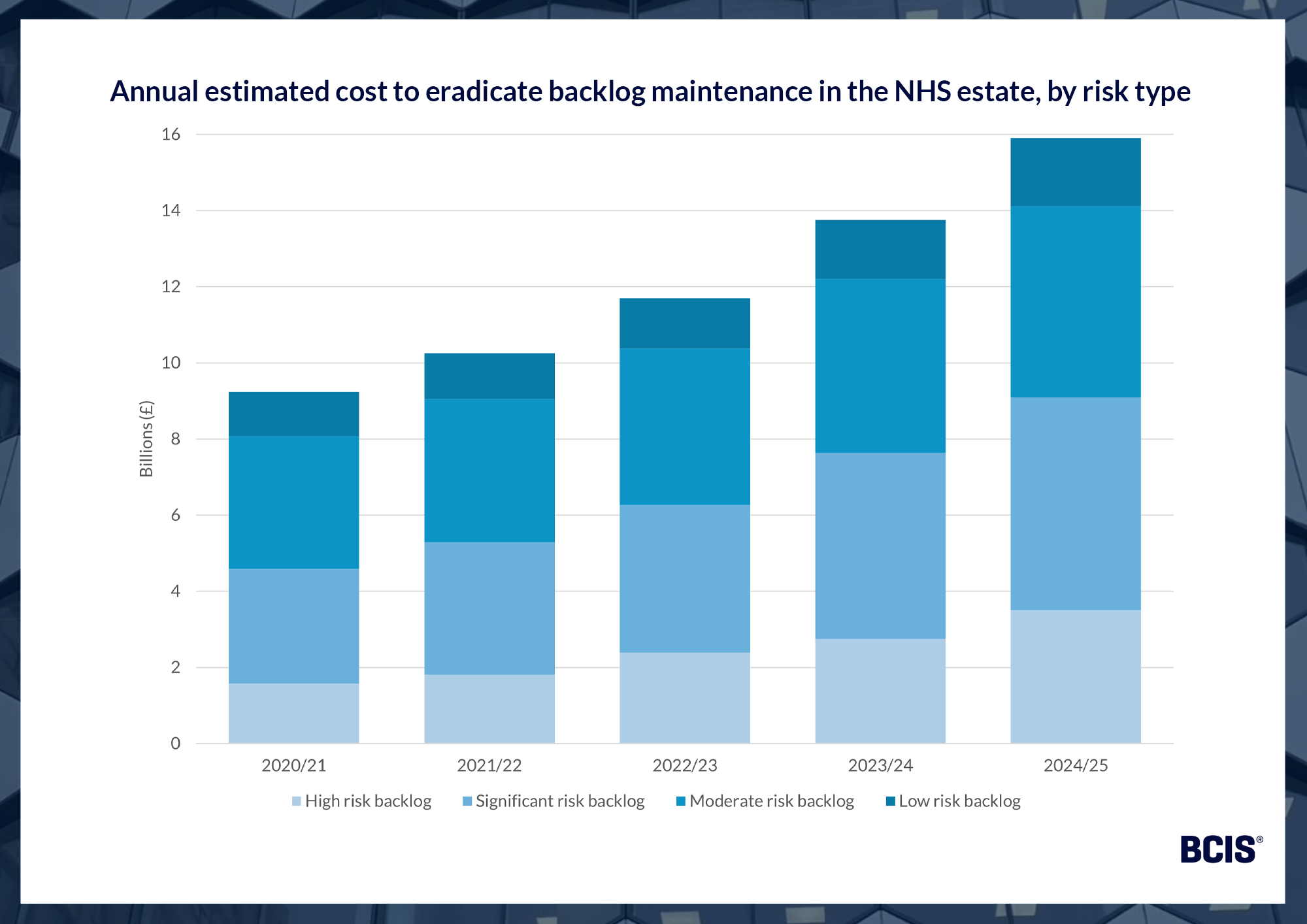
The total estimated cost to eradicate backlog maintenance in the NHS estate climbed to £15.9 billion in the 2024/25 financial year, according to the latest Estates Returns Information Collection (ERIC)(1).
This was a 15.7% increase on the £13.8 billion estimated in 2023/24 and a rise of more than two-thirds (72.3%) on the £9.2 billion estimated five years ago.
The new figures follow Lord Darzi’s independent investigation into the NHS last year which highlighted a £37 billion shortfall in capital investment, relative to peer countries’ level of capital investment in the 2010s(2).
Darzi’s summary concluded that the NHS’s capital budget has been used to plug holes in day-to-day spending and claimed the missing £37 billion could have prevented backlog maintenance, modernised technology and equipment, and paid for the 40 new hospitals promised by the then-government.
Reflecting on the latest ERIC release, BCIS data services director, Karl Horton, said: ‘Growth in the annual cost to eliminate NHS backlog maintenance was unfortunately to be expected.
‘The cost of construction is rising due to a number of factors, including labour shortages and high business costs, which is only driving up the level of investment needed to build or repair hospitals and other healthcare assets. Add to that the chronic lack of investment in the NHS over the last decade or more and it’s almost surprising the backlog cost isn’t higher.’
According to the latest BCIS maintenance, cleaning and energy briefing, the BCIS All-in Maintenance Cost Indices, which represent the movement of maintenance costs in the whole economy, are forecast to rise 15% by 2Q2030.
Cleaning costs specifically are expected to grow by 24%, largely driven by labour costs.
In the NHS, the estimated cost of backlog maintenance is a measure of how much would need to be invested to restore a building to a certain state. This does not cover planned maintenance and is categorised by a risk criteria depending on the urgency or severity of required works.
Source: NHS Estates Returns Information Collection
In 2024/25, works classed under ‘significant risk’ comprised the largest share of the total estimated cost at £5.6 billion. This was followed by works classed under ‘moderate risk’ at £5.0 billion.
ERIC data also show how much is invested in reducing backlog maintenance each year.
This is categorised by similar criteria – investment in assets with critical infrastructure risk (CIR) and non-critical infrastructure risk.
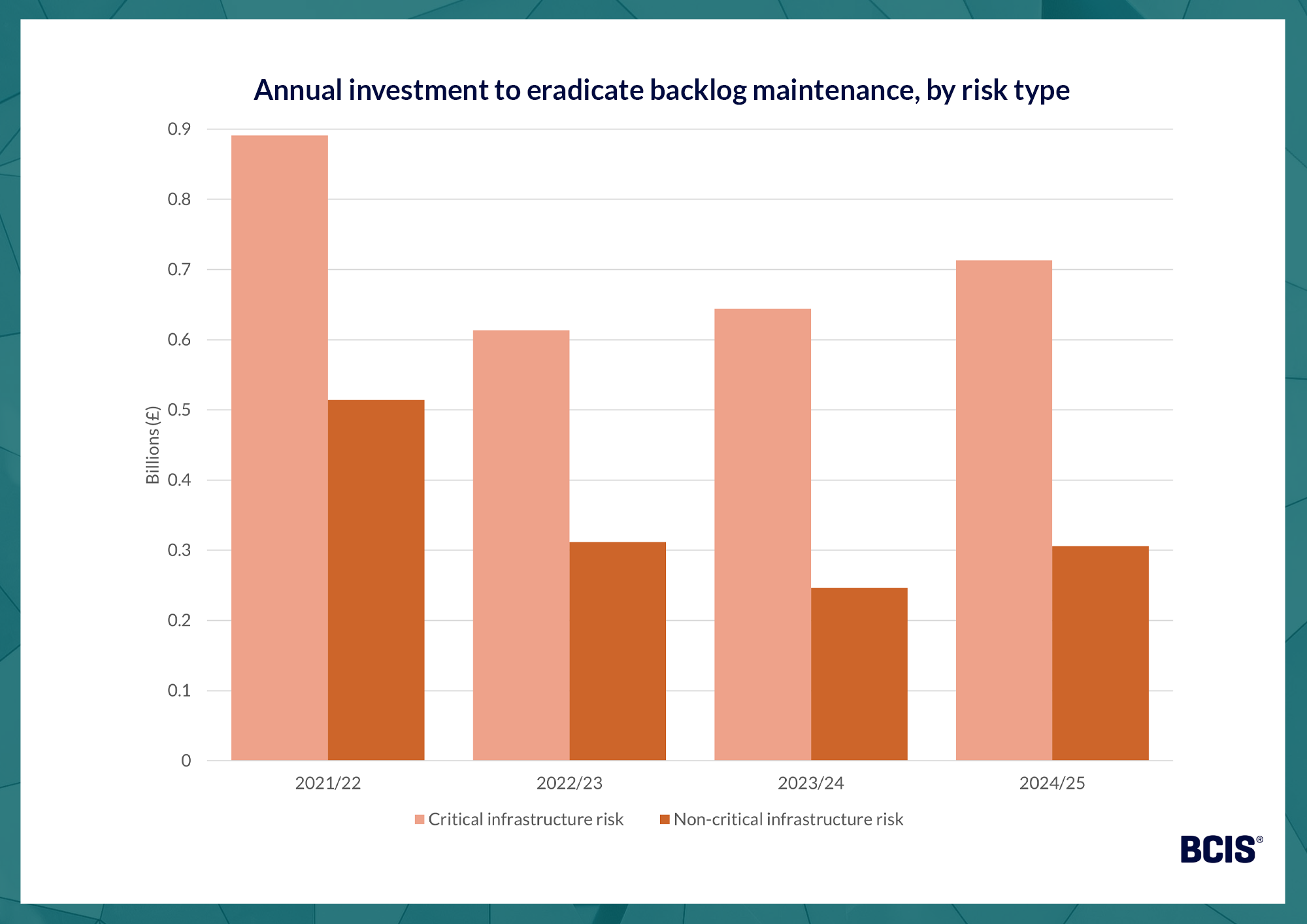
In 2024/25, just over £1 billion was invested in reducing backlog maintenance.
Source: NHS Estates Returns Information Collection
This was a 14.5% increase on the £890 million annual investment made in 2023/24 but a 27.5% fall on the £1.4 billion invested in 2021/22 – the highest level in the last five years.
‘Despite the public sector’s squeezed pockets, investment efforts to reduce backlog maintenance seem to be rising gradually. The trick now is whether the government can raise the necessary funds in the Autumn Budget to start delivering on multi-billion-pound pledges to attack the backlog mountain further’, Horton added.
‘Even in the best-case scenario, this is a huge ask under current economic conditions and it’s likely the government will have to revisit private finance models for social infrastructure.
‘Of course, the success of these will depend on whether the pitfalls of past models can be overcome. It’s no easy task – unlike transport and energy infrastructure, hospitals and other publicly-owned healthcare assets are not revenue-generating and are therefore an unnatural fit for models like the Regulated Asset Base.
‘However, with few options on the table and the weight of backlog costs mounting, turning private finance into a silver lining might be the best and only way forward.’
To keep up to date with the latest industry news and insights from BCIS, register for our newsletter here.
Share on social media